权威指南: Compostable vs Plastic Cups ̵
可堆肥与塑料杯 – Making the Sustainable Choice
在当今注重环保的市场中, the choice between compostable cups and traditional plastic cups represents more than just packaging—it’s a statement about brand values, environmental responsibility, and long-term sustainability. With plastic waste polluting oceans and landfills overflowing, businesses worldwide face increasing pressure to make smarter packaging choices. This guide examines the critical differences between these options, providing data-driven insights to inform your business decisions.

Part 1: 材料成分 & Origins
1.1 Compostable Cups: Nature-Based Innovation
Compostable cups primarily utilize materials that break down into non-toxic components within specific timeframes under proper conditions.
Primary Materials:
- 解放军 (聚乳酸): Derived from fermented plant starch (corn, 蔗, 木薯). Companies like 深圳市雅斯泰包装制品有限公司, 有限公司, with their 24+ 年 of industry experience, specialize in manufacturing these advanced 可堆肥 PLA 杯子.
- PHA (Polyhydroxyalkanoates): Produced by microorganisms consuming plant sugars
- Paper with Compostable Liners: Utilizing plant-based coatings instead of plastic laminates
Key Certification Standards:
- ASTM D6400: US standard for industrial compostability
- 在 13432: European standard requiring 90% breakdown within 90 天
- BPI认证: Third-party verification in North America
1.2 Traditional Plastic Cups: Petroleum-Dependent Technology
Conventional plastic cups rely on finite fossil fuel resources.
Primary Materials:
- 宠物 (聚对苯二甲酸乙二醇酯): Clear, strong plastic for cold beverages
- 聚丙烯 (聚丙烯): Flexible, heat-resistant plastic for hot drinks
- 聚苯乙烯 (聚苯乙烯): Lightweight foam cups (banned in many regions)
Manufacturing Footprint:
The production of traditional plastics accounts for approximately 6% of global oil consumption and 1.5% of greenhouse gas emissions.
Part 2: Environmental Impact Comparison

2.1 Life Cycle Analysis Breakdown
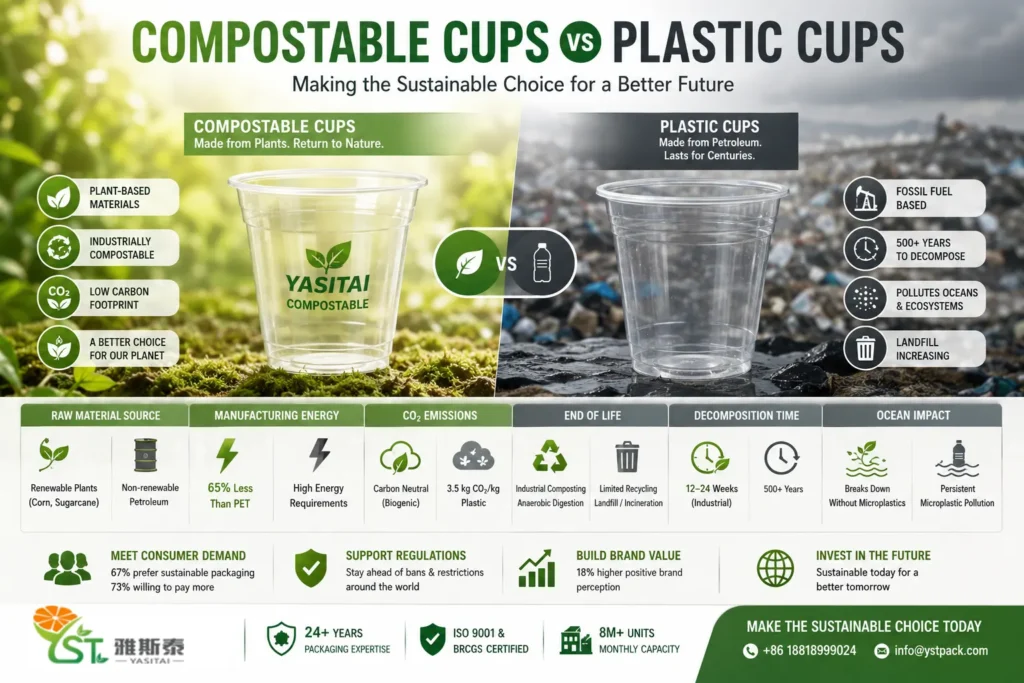
| Impact Category | Compostable Cups | PET Plastic Cups | PP Plastic Cups |
|---|---|---|---|
| Raw Material Source | Renewable plants | Non-renewable petroleum | Non-renewable petroleum |
| Manufacturing Energy | 65% less than PET | High energy requirements | High energy requirements |
| CO₂ Emissions | Carbon neutral (biogenic) | 3.5 kg CO₂/kg plastic | 3.2 kg CO₂/kg plastic |
| End of Life Options | 工业堆肥, anaerobic digestion | Limited recycling, landfill, incineration | Limited recycling, landfill, incineration |
| Decomposition Time | 12-24 周 (工业的) | 500+ 年 | 500+ 年 |
| Ocean Impact | Breaks down without microplastics | Persistent microplastic pollution | Persistent microplastic pollution |
2.2 Waste Management Realities
Compostable System Requirements:
- Industrial Facilities: Required for proper breakdown (90+ 天, 60℃)
- Consumer Education: Essential for proper disposal sorting
- Collection Infrastructure: Developing but incomplete in many regions
Plastic Recycling Limitations:
- 仅有的 9% of plastic waste gets recycled globally
- Contamination issues reduce PET cup recyclability
- Food residue often renders cups unrecyclable
Part 3: 表现 & Application Analysis
3.1 Functional Performance Comparison
Temperature Tolerance:
- 可堆肥 PLA 杯: Optimal 0-50°C (perfect for iced beverages)
- 宠物杯: Excellent for cold beverages (-40 to 70°C)
- PP杯: Suitable for hot drinks (up to 135°C)
Structural Integrity:
- Premium compostable cups from experienced manufacturers now match PET’s clarity and rigidity
- Modern PLA formulations maintain liquid integrity for 24+ 小时
- Advanced production techniques, like those used by Yasitai, ensure consistent wall thickness and leak resistance
成本考虑:
- Compostable Cups: 15-40% premium over conventional plastics (decreasing with scale)
- 塑料杯: Lower upfront cost but potential hidden expenses (ESG compliance, waste fees)
- Total Cost of Ownership: Increasingly favors compostables with rising carbon taxes
3.2 Business Applications Optimization
For Different Business Needs:
1. 食物 & Beverage Service:
- Compostable Preferred: Cold beverage shops, 果汁棒, smoothie chains
- Hybrid Solution: Coffee shops using PLA for cold cups, PP for hot lids
- Full Implementation: Fast casual restaurants adopting complete compostable serveware systems
2. Corporate & Institutional Use:
- Office Coffee Service: Compostable cups demonstrate sustainability commitments
- Event Management: Music festivals and conferences reducing waste liability
- Healthcare Facilities: Reducing plastic waste in cafeterias
3. Retail Packaging:
- Premium Products: Yogurt, 甜点, ready-to-drink beverages in compostable cups
- Brand Alignment: Connecting package material with product values (organic, natural, 环保)
Part 4: Regulatory & Market Landscape
4.1 Global Regulatory Trends
- 欧洲联盟: Single-Use Plastics Directive banning certain plastic items
- 美国: 14 states with plastic cup restrictions or bans
- 加拿大: Comprehensive plastics reduction strategy
- 亚洲: Increasing Extended Producer Responsibility (EPR) regulations
4.2 Consumer Demand Shifts
Market research indicates:
- 67% of consumers prefer sustainable packaging
- 73% would pay premium for environmentally friendly products
- 82% of millennials expect brands to demonstrate sustainability
- Brand reputation impact: Companies using compostable packaging see 18% higher positive perception
4.3 Sourcing Considerations for Businesses
When evaluating suppliers, consider:
| Factor | Importance | Key Questions |
|---|---|---|
| Certifications | Critical | ASTM D6400? 在 13432? BPI certified? |
| Manufacturing Capacity | Operational | Monthly output? Lead times? Scalability? |
| Material Options | 灵活的 | Multiple compostable resins? Hybrid solutions? |
| Technical Support | Strategic | Custom formulation? Testing support? Migration analysis? |
Part 5: Transition Strategy & Implementation
5.1 Phased Adoption Roadmap
阶段 1: Assessment (Months 1-2)
- Waste Audit: Analyze current cup usage and disposal patterns
- Facility Survey: Verify composting infrastructure availability
- Supplier Evaluation: Assess manufacturers like Shenzhen Yasitai who offer comprehensive packaging solutions
- Cost Analysis: Calculate total transition expenses and ROI
阶段 2: Pilot Program (Months 3-4)
- Select test locations with supportive customer demographics
- Train staff on proper handling and disposal messaging
- Monitor performance: Leakage rates, 客户反馈, cost tracking
- Order sample quantities for real-world testing
阶段 3: Full Implementation (Months 5-8)
- Establish consistent supply chain with reliable manufacturers
- Implement consumer education through signage and digital campaigns
- Track metrics: Waste reduction, cost impacts, customer satisfaction
- Communicate achievements through marketing channels
阶段 4: Optimization & Expansion (Ongoing)
- Continuous improvement based on performance data
- Expand to related items: Lids, 吸管, 容器 (consider 寿司盒 for food applications)
- Engage stakeholders through sustainability reporting
5.2 Common Challenges & Solutions
Challenge 1: Cost Premium
- Solution: Negotiate volume discounts, phase implementation, calculate long-term savings from waste reduction
Challenge 2: Contamination in Composting Streams
- Solution: Clear labeling, customer education, staff training programs
Challenge 3: Performance Concerns
- Solution: Work with technical manufacturers for custom formulations addressing specific needs (耐热性, grease barrier)
Challenge 4: Inconsistent Supply
- Solution: Partner with established manufacturers with proven production capabilities and adequate 月产值
Part 6: Future Outlook & 创新
6.1 Material Science Advancements
- Temperature-Resistant PLA: Emerging technologies enabling hot beverage compatibility
- Marine-Degradable Formulations: Breaking down in ocean environments within 6-12 月份
- 增强的屏障特性: Extending shelf life for food applications
6.2 Infrastructure Development
- Urban Composting Hubs: Municipal investments expanding access
- Smart Collection Systems: RFID tagging for efficient sorting
- Chemical Recycling Technologies: Breaking down materials for repolymerization
6.3 Economic Shifts
- Plastic Taxes: Increasing costs for conventional plastics
- Circular Economy Incentives: Government support for compostable systems
- Supply Chain Optimization: Scaling production reducing cost differentials
结论: Making an Informed Choice
The transition from plastic to compostable cups isn’t just an environmental decision—it’s a strategic business move that aligns with evolving consumer preferences, regulatory trends, and long-term economic realities.
Key Decision Factors:
- Brand Alignment: Does compostable packaging support your brand values?
- Operational Feasibility: Do you have access to composting infrastructure?
- Economic Viability: Can you manage the transition costs and potential price adjustments?
- 客户期望: Are your customers demanding sustainable options?
- 监管合规性: Are you operating in regions with current or pending plastic restrictions?
For businesses ready to transition:
Partner with experienced manufacturers who understand both the technical requirements and practical implementation challenges. Companies with 24+ years in the industry bring valuable expertise in balancing performance, 成本, 和可持续性.
Next Steps:
- Request samples to evaluate real-world performance with your products
- Consult technical experts at manufacturers like Shenzhen Yasitai Packaging about custom solutions
- Calculate total cost including waste management savings and brand value enhancement
- Develop communication strategy to maximize customer engagement and brand benefit
The cup you choose today communicates volumes about your business tomorrow. As the founder of 深圳市雅斯泰包装制品有限公司, 有限公司 would advise: “Sustainable packaging isn’t an expense—it’s an investment in your brand’s future.”
Ready to explore compostable solutions for your business?
Contact our team at +86 18818999024 or [email protected] for:
- Free product samples
- Custom formulation consultations
- Comprehensive transition planning
- Technical specification sheets and certification documentation
The information in this guide is based on industry data, manufacturer specifications, and environmental research. Performance may vary based on specific applications and conditions. Always test products with your specific use case.