解放军杯 vs. 宠物杯: 哪种是最好的环保 Cho

解放军杯 vs. 宠物杯: Which is the Best Eco-Friendly Choice for Your Business?

In the rapidly evolving landscape of global beverage packaging, procurement managers and supply chain directors face a critical crossroads. As consumer demand for sustainability reaches an all-time high and regulatory pressures—such as the EU’s Single-Use Plastics Directive (SUPD)—tighten, the choice of material for cold drink containers has never been more consequential. Central to this debate is the PLA cup versus the traditional PET cup. While both offer distinct advantages in terms of clarity and performance, the fundamental confusion between “可堆肥的” 和 “可回收” often leads to misaligned sustainability strategies and operational inefficiencies.

For a beverage brand owner, the decision is not merely about aesthetic appeal; it is a complex calculation involving material science, regional waste management infrastructure, carbon footprint analysis, and cost-to-value ratios. This article provides an authoritative deep dive into the technical properties, environmental impacts, and strategic decision frameworks required to determine whether the PLA cup or the PET cup is the superior choice for your enterprise.

1. Understanding the Material Origins: 解放军 vs. 宠物

To make an informed procurement decision, one must first understand the molecular foundations of these two polymers. Although they may look nearly identical to the naked eye, their chemical heritage and end-of-life pathways are diametrically opposed.

聚乳酸 (解放军): The Bio-Based Contender

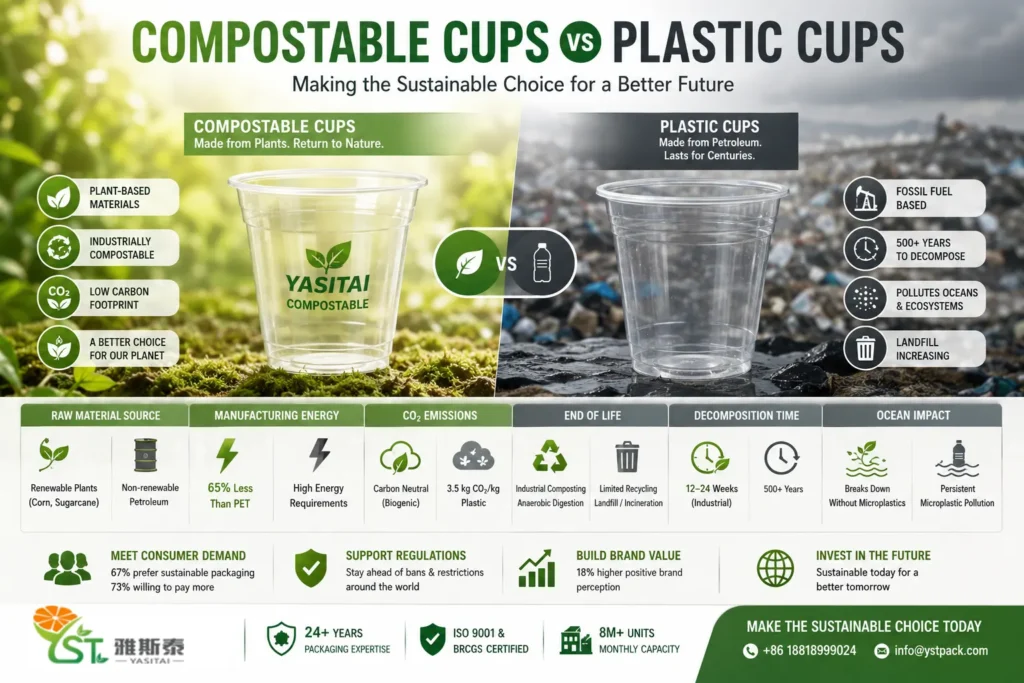
PLA cup is manufactured from Polylactic Acid, a thermoplastic polyester derived from renewable biomass. Typically, this involves the fermentation of plant starch—most commonly corn, 蔗, or sugar beet—into lactic acid, which is then polymerized. Because it is derived from annually renewable crops rather than fossil fuels, PLA is often marketed as a carbon-neutral alternative. From a technical standpoint, PLA is a bio-based, bioactive thermoplastic that offers acradle-to-gatecarbon footprint significantly lower than petroleum-based plastics.

聚对苯二甲酸乙二醇酯 (宠物): The Recycling Gold Standard

聚对苯二甲酸乙二醇酯 (宠物) is a petroleum-derived polyester. It has been the industry standard for decades due to its exceptional strength-to-weight ratio, gas barrier properties, and unmatched clarity. Unlike PLA, PET is a highly stable polymer that does not degrade under standard environmental conditions. 然而, its primary strength in a circular economy lies in its recyclability. PET is the most recycled plastic globally, with a mature infrastructure (再生聚酯) that allows for multiple life cycles, reducing the need for virgin resin extraction.

2. Comparative Analysis: 明晰, 耐热性, and Performance

When evaluating a PLA cup against a PET counterpart for commercial use, performance metrics in theuse phaseare paramount for maintaining brand integrity and consumer satisfaction.

Optical Clarity and Aesthetic Appeal

Both materials offer “晶莹剔透” transparency, which is essential for showcasing the vibrant colors of juices, 冰咖啡, and craft sodas. PET traditionally held the edge in gloss andsparkle.” 然而, modern high-grade PLA resin technology has closed this gap. A premium PLA cup now delivers the same premium look and feel as PET, ensuring that the switch to a bio-based material does not result in a perceived drop in quality for the end-user.

Thermal Stability and Structural Integrity

This is where the two materials diverge significantly. Standard PLA has a relatively low glass transition temperature (typically between 55°C and 60°C). Consequently, a standard PLA cup is strictly limited to cold beverage applications. Exposure to high ambient temperatures during transit or storage in non-climate-controlled warehouses can lead to deformation. 相比之下, PET remains stable up to approximately 70°C, providing a slightly wider margin of safety for supply chains operating in tropical climates. For brands requiring heat resistance for hot-fill applications, specialized CPLA (Crystallized PLA) exists, though it sacrifices the transparency found in standard PLA cups.

3. The Environmental Paradox: Industrial Composting vs. Physical Recycling

The core of thePLA cup vs. 聚酯杯” debate lies in the end-of-life processing. Misunderstanding these pathways can lead togreenwashingaccusations or unintended environmental harm.

The Lifecycle of a PLA Cup

The primary value proposition of the PLA cup is that it iscompostable.” 然而, it is critical to note that PLA is industrially compostable (ASTM D6400 or EN 13432 标准). It will not break down in a backyard compost bin or a marine environment within a reasonable timeframe. In an industrial composting facility, where temperature, 水分, and microbial activity are tightly controlled, a PLA cup will disintegrate into water, CO2, and biomass in under 90 天. If your brand operates in a region with robust organic waste collection and industrial composting infrastructure, PLA offers a truly circular, zero-waste solution.

The Circularity of RPET

While PET is derived from fossil fuels, its environmental story has shifted toward theClosed-Loopmodel. Because PET is easily sorted by NIR (Near-Infrared) sensors in recycling facilities, it can be washed, shredded, and pelletized back into food-grade RPET (再生聚酯). For a supply chain director, utilizing PET means tapping into a global system where the material can be reclaimed. The carbon footprint of an RPET cup can, in some instances, rival that of a bio-based cup when the logistics of composting are factored in.

4. Decision Framework: How to Choose for Your Business

Procurement managers should utilize the following framework when deciding whether to standardize on the PLA cup or stick with PET/RPET.

Infrastructure Assessment

  • Choose PLA if: Your primary markets have established commercial composting streams (例如。, parts of Northern Europe, San Francisco, or Seattle). PLA is the ultimatestatementmaterial for brands committed to a plant-based future.
  • Choose PET/RPET if: Your consumer base relies on curbside recycling. Throwing a PLA cup into a plastic recycling bin can actually contaminate the PET stream, as the two materials cannot be recycled together.

Brand Narrative and Consumer Education

If your brand identity is built onPlant-Based” 或者 “Naturalingredients, 这 PLA cup reinforces that message perfectly. 然而, it requires clear labeling to ensure consumers dispose of it in the organics bin. If your brand focuses onZero Waste” 和 “Circular Economy,” an RPET cup with a high percentage of post-consumer content may be more aligned with your goals.

Regulatory Landscape

Stay ahead of legislation. Many jurisdictions are moving to ban non-compostable plastics in specific settings (such as festivals or closed-loop stadiums). In these environments, 这 PLA cup is often the only compliant option for disposable drinkware.

5. Manufacturing Excellence: The Yastai Advantage

Regardless of whether your strategy calls for the compostable PLA cup or the highly recyclable PET cup, the quality of the manufacturer is the final piece of the puzzle. 在亚斯塔 (雅斯泰), we have spent over 25 years perfecting the art and science of beverage packaging.

Dual Capability in PLA and RPET

Yastai is one of the few global manufacturers with the specialized extrusion and thermoforming lines required to produce both high-clarity PLA and food-grade RPET products. We understand that aone size fits allapproach does not work for global supply chains. Our dual capability allows us to act as a strategic partner, providing the PLA cup for your eco-forward markets and RPET solutions for your high-volume retail channels.

Quality Assurance and Global Standards

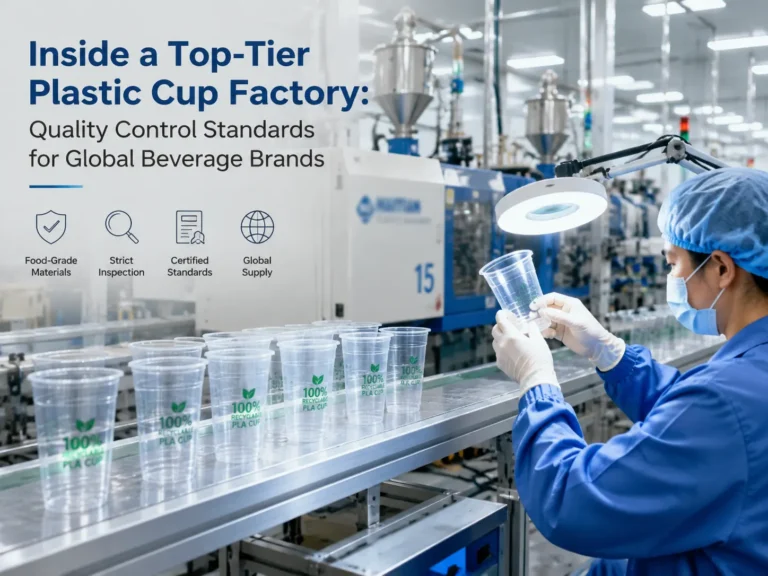
In the B2B sector, certifications are the currency of trust. Yastai proudly maintains a BRC A+ rating, the highest tier of the Global Standard for Food Safety. This ensures that every cup—whether bio-based or recycled—meets the most stringent migration and hygiene standards required by multinational beverage brands. 我们的 25 years of expertise mean we have solved the common issues of lid-fit consistency, stackability, and rim-smoothness that often plague lesser manufacturers.

结论: The Future is Tailored

The choice between a PLA cup and a PET cup is not a matter of which material isbetterin a vacuum, but which is more effective for your specific logistical and environmental context. PLA offers a revolutionary departure from fossil fuels and a clean end-of-life in composting-ready markets. PET offers a proven, 耐用的, and highly recyclable path for mainstream circularity.

As you navigate these complex supply chain decisions, partner with a manufacturer that offers technical authority, certified safety, and a quarter-century of experience. 亚斯塔伊 (雅斯泰) stands ready to help you implement a packaging strategy that protects your product, satisfies your customers, and respects the planet.

Contact Yastai today to request technical specifications or samples of our premium PLA and RPET cup ranges.


类似文章