Copa PLA vs.. Taza de mascota: ¿Cuál es el mejor cho ecológico?
Copa PLA vs.. Taza de mascota: ¿Cuál es la mejor opción ecológica para su negocio??
En el panorama en rápida evolución del envasado de bebidas a nivel mundial, Los gerentes de adquisiciones y los directores de la cadena de suministro enfrentan una encrucijada crítica.. A medida que la demanda de sostenibilidad de los consumidores alcanza un máximo histórico y las presiones regulatorias, como la Directiva sobre plásticos de un solo uso de la UE (SUPD)-apretar, La elección del material para los envases de bebidas frías nunca ha sido tan importante.. Un elemento central de este debate es el taza de PLA versus la taza de PET tradicional. Si bien ambos ofrecen distintas ventajas en términos de claridad y rendimiento, la confusión fundamental entre “compostable” y “reciclable” A menudo conduce a estrategias de sostenibilidad desalineadas e ineficiencias operativas..
Para el propietario de una marca de bebidas, la decisión no se trata simplemente de un atractivo estético; es un cálculo complejo que involucra la ciencia de los materiales, infraestructura regional de gestión de residuos, análisis de huella de carbono, y relaciones costo-valor. Este artículo proporciona una inmersión profunda y autorizada en las propiedades técnicas., impactos ambientales, y marcos de decisión estratégicos necesarios para determinar si el vaso de PLA o el vaso de PET es la mejor opción para su empresa..
1. Comprender los orígenes materiales: PLA frente a. MASCOTA
Para tomar una decisión de adquisición informada, Primero hay que entender los fundamentos moleculares de estos dos polímeros.. Aunque pueden parecer casi idénticos a simple vista, su herencia química y sus vías al final de su vida son diametralmente opuestas.
Ácido poliláctico (PLA): El contendiente de base biológica
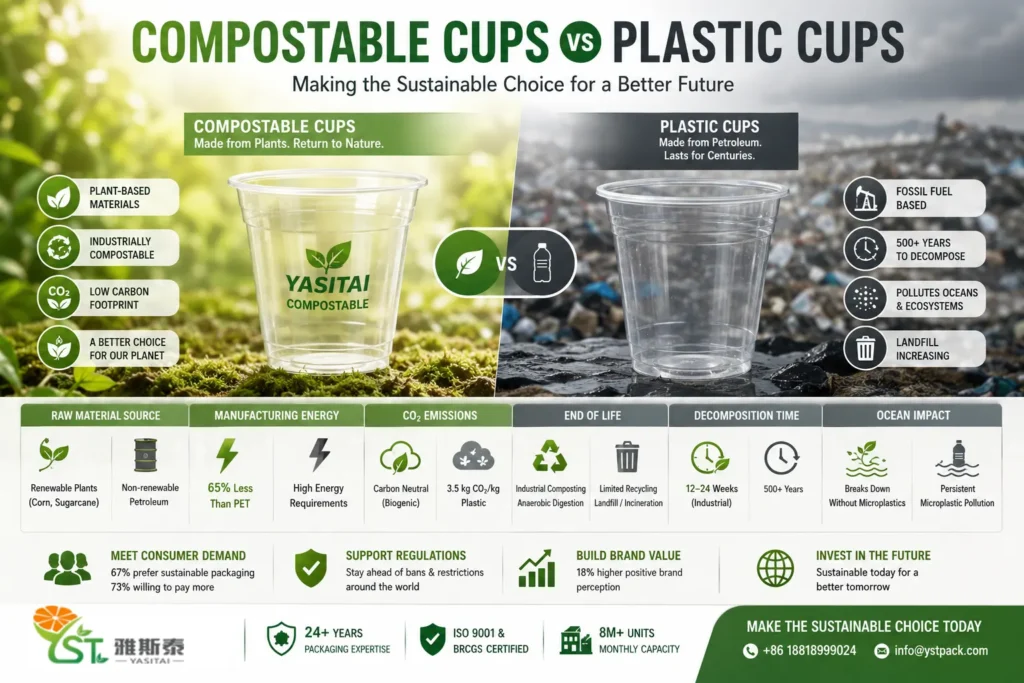
El taza de PLA está fabricado a partir de ácido poliláctico, un poliéster termoplástico derivado de biomasa renovable. Típicamente, Esto implica la fermentación de almidón vegetal, más comúnmente maíz., Caña de azúcar, o remolacha azucarera, en ácido láctico, que luego se polimeriza. Porque se deriva de cultivos anualmente renovables en lugar de combustibles fósiles., El PLA a menudo se comercializa como una alternativa neutra en carbono.. Desde un punto de vista técnico, El PLA es de base biológica., termoplástico bioactivo que ofrece una “desde la cuna hasta la puerta” Huella de carbono significativamente menor que la de los plásticos a base de petróleo..
Tereftalato de polietileno (MASCOTA): El estándar de oro del reciclaje
Tereftalato de polietileno (MASCOTA) es un poliéster derivado del petróleo. Ha sido el estándar de la industria durante décadas debido a su excepcional relación resistencia-peso., propiedades de barrera a los gases, y claridad inigualable. A diferencia del PLA, El PET es un polímero altamente estable que no se degrada en condiciones ambientales estándar.. Sin embargo, Su principal fortaleza en una economía circular radica en su reciclabilidad.. El PET es el plástico más reciclado a nivel mundial, con una infraestructura madura (RPET) que permite múltiples ciclos de vida, reduciendo la necesidad de extracción de resina virgen.
2. Análisis comparativo: Claridad, Resistencia al calor, y rendimiento
Al evaluar un taza de PLA contra una contraparte de PET para uso comercial, métricas de desempeño en el “fase de uso” Son fundamentales para mantener la integridad de la marca y la satisfacción del consumidor..
Claridad óptica y atractivo estético
Ambos materiales ofrecen “claro” transparencia, que es esencial para mostrar los colores vibrantes de los jugos, cafés helados, y refrescos artesanales. El PET tradicionalmente mantenía el borde en brillo y “brillar.” Sin embargo, La moderna tecnología de resina PLA de alta calidad ha cerrado esta brecha.. Una prima taza de PLA ahora ofrece la misma apariencia premium que el PET, Garantizar que el cambio a un material de origen biológico no dé como resultado una caída percibida en la calidad para el usuario final..
Estabilidad térmica e integridad estructural
Aquí es donde los dos materiales divergen significativamente.. El PLA estándar tiene una temperatura de transición vítrea relativamente baja (normalmente entre 55°C y 60°C). Como consecuencia, un estándar taza de PLA está estrictamente limitado a aplicaciones de bebidas frías. La exposición a altas temperaturas ambiente durante el transporte o el almacenamiento en almacenes sin clima controlado puede provocar deformaciones.. En contraste, El PET permanece estable hasta aproximadamente 70°C, Proporcionar un margen de seguridad ligeramente más amplio para las cadenas de suministro que operan en climas tropicales.. Para marcas que requieren resistencia al calor para aplicaciones de llenado en caliente, CPLA especializada (PLA cristalizado) existe, aunque sacrifica la transparencia que se encuentra en los vasos de PLA estándar.
3. La paradoja ambiental: Compostaje industrial vs.. Reciclaje Físico
El núcleo de la “taza de PLA vs.. taza de mascota” El debate radica en el procesamiento al final de la vida.. Entender mal estas vías puede conducir a “lavado verde” acusaciones o daños ambientales no intencionados.
El ciclo de vida de una copa PLA
La principal propuesta de valor de la taza de PLA es que es “compostable.” Sin embargo, Es fundamental tener en cuenta que el PLA es compostable industrialmente (ASTM D6400 o EN 13432 estándares). No se descompondrá en un contenedor de abono de jardín ni en un entorno marino en un plazo de tiempo razonable.. En una instalación de compostaje industrial, donde la temperatura, humedad, y la actividad microbiana están estrictamente controladas, un vaso de PLA se desintegrará en agua, CO2, y biomasa en menos 90 días. Si su marca opera en una región con una sólida infraestructura de recolección de residuos orgánicos y compostaje industrial., PLA ofrece una solución verdaderamente circular, solución sin desperdicio.
La circularidad de RPET
Mientras que el PET se deriva de combustibles fósiles, su historia ambiental se ha desplazado hacia la “Circuito cerrado” modelo. Porque el PET se clasifica fácilmente mediante NIR (Infrarrojo cercano) sensores en instalaciones de reciclaje, se puede lavar, triturado, y peletizado nuevamente en RPET de calidad alimentaria (PET reciclado). Para un director de cadena de suministro, Utilizar PET significa acceder a un sistema global donde el material puede ser recuperado.. La huella de carbono de un vaso de RPET puede, en algunos casos, rivaliza con el de un vaso de base biológica cuando se tiene en cuenta la logística del compostaje.
4. Marco de decisión: Cómo elegir para su negocio
Los gerentes de adquisiciones deben utilizar el siguiente marco al decidir si estandarizar en el taza de PLA o quédese con PET/RPET.
Evaluación de infraestructura
- Elija PLA si: Sus mercados principales han establecido flujos de compostaje comercial. (p.ej., partes del norte de europa, san francisco, o seattle). PLA es lo último “declaración” material para marcas comprometidas con un futuro plant-based.
- Elija PET/RPET si: Su base de consumidores depende del reciclaje en la acera. Lanzar un taza de PLA en un contenedor de reciclaje de plástico puede contaminar el flujo de PET, ya que los dos materiales no se pueden reciclar juntos.
Narrativa de marca y educación del consumidor
Si su identidad de marca se basa en “A base de plantas” o “Natural” ingredientes, el taza de PLA refuerza perfectamente ese mensaje. Sin embargo, Requiere un etiquetado claro para garantizar que los consumidores lo desechen en el contenedor de productos orgánicos.. Si tu marca se centra en “Desperdicio Cero” y “Economía circular,” un vaso RPET con un alto porcentaje de contenido posconsumo puede estar más alineado con sus objetivos.
Panorama regulatorio
Manténgase a la vanguardia de la legislación. Muchas jurisdicciones están tomando medidas para prohibir los plásticos no compostables en entornos específicos. (como festivales o estadios de circuito cerrado). En estos ambientes, el taza de PLA A menudo es la única opción compatible para vasos desechables..
5. Excelencia en fabricación: La ventaja de Yastai
Independientemente de si tu estrategia requiere el compostable taza de PLA o el vaso de PET altamente reciclable, la calidad del fabricante es la última pieza del rompecabezas. En Yastai (Yaste), hemos gastado más 25 Años perfeccionando el arte y la ciencia del envasado de bebidas..
Capacidad dual en PLA y RPET
Yastai es uno de los pocos fabricantes globales con las líneas especializadas de extrusión y termoformado necesarias para producir productos tanto de PLA de alta claridad como de RPET de calidad alimentaria.. Entendemos que un “talla única” El enfoque no funciona para las cadenas de suministro globales.. Nuestra doble capacidad nos permite actuar como un socio estratégico, proporcionando el taza de PLA para sus mercados ecológicos y soluciones RPET para sus canales minoristas de gran volumen.
Garantía de calidad y estándares globales
En el sector B2B, Las certificaciones son la moneda de confianza.. Yastai mantiene con orgullo un Clasificación BRC A+, el nivel más alto del Estándar Global para la Seguridad Alimentaria. Esto garantiza que cada taza, ya sea de base biológica o reciclada, cumpla con los estándares de migración e higiene más estrictos exigidos por las marcas multinacionales de bebidas.. Nuestro 25 Años de experiencia significan que hemos resuelto los problemas comunes de consistencia del ajuste de la tapa., apilabilidad, y suavidad de las llantas que a menudo afectan a los fabricantes menores.
Conclusión: El futuro está a su medida
La elección entre un taza de PLA y una taza de PET no es una cuestión de qué material es “mejor” en el vacío, pero cuál es más efectivo para su contexto logístico y ambiental específico. El PLA ofrece un alejamiento revolucionario de los combustibles fósiles y un final de vida limpio en los mercados preparados para el compostaje. PET ofrece una probada, durable, y un camino altamente reciclable para la circularidad generalizada.
Mientras navega por estas complejas decisiones sobre la cadena de suministro, asociarse con un fabricante que ofrezca autoridad técnica, seguridad certificada, y un cuarto de siglo de experiencia. yastai (Yaste) está listo para ayudarlo a implementar una estrategia de empaque que proteja su producto, satisface a tus clientes, y respeta el planeta.
Contacto yastai hoy para solicitar especificaciones técnicas o muestras de nuestras gamas premium de vasos PLA y RPET.