Disposable Takeaway Containers: Essential B2B Sourcing
If you have ever managed commercial kitchens or regional food distribution, you know the frustration of lid popping, sauce leakage, and clouded display boxes during delivery. The solution lies in engineering precision: high-clarity, rigid disposable takeaway containers manufactured to strict food safety standards. At Yasitai (YST Pack), our automated thermoforming lines produce over 300 million units monthly, giving restaurants and wholesalers the structural consistency they demand.
Selecting the right container protects your brand reputation and minimizes costly customer refunds. In this comprehensive guide, we unpack material science, lid-locking mechanics, thermal thresholds, and the exact compliance verification steps required for commercial foodservice procurement.
Table of Contents
Why Material Selection Dictates Performance in Disposable Takeaway Containers
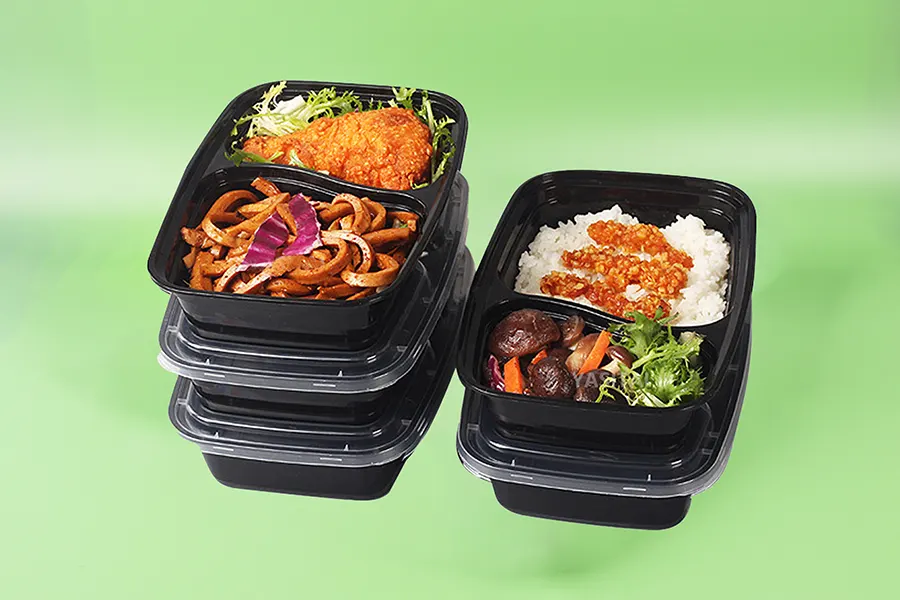
Every commercial food application demands specific polymer properties to withstand temperature swings, grease contact, and stacking pressure. Polypropylene (PP) remains the industry benchmark for hot entrees, microwave reheating, and oil-heavy recipes due to its heat tolerance up to 120°C. Conversely, Polyethylene Terephthalate (PET) delivers unmatched optical clarity for refrigerated fresh salads, deli slices, and cold desserts.
In our 24+ years of manufacturing practice, blending virgin resin with precise thermoforming temperature control prevents wall thinning at bottom corners. When evaluating commercial containers, buyers must ensure sidewall thickness remains uniform across high-stress perimeter zones. Inconsistent wall thickness often causes corner crushing during multi-tier motorcycle delivery.
For eco-conscious restaurant chains, certified Polylactic Acid (PLA) and recycled RPET polymers offer verified carbon reduction without sacrificing structural rigidity. By matching resin grade to exact serving temperatures, buyers eliminate warping and preserve freshness from kitchen prep to customer doorstep.
How Anti-Fog Engineering and Snap-Fit Lids Protect Food Quality
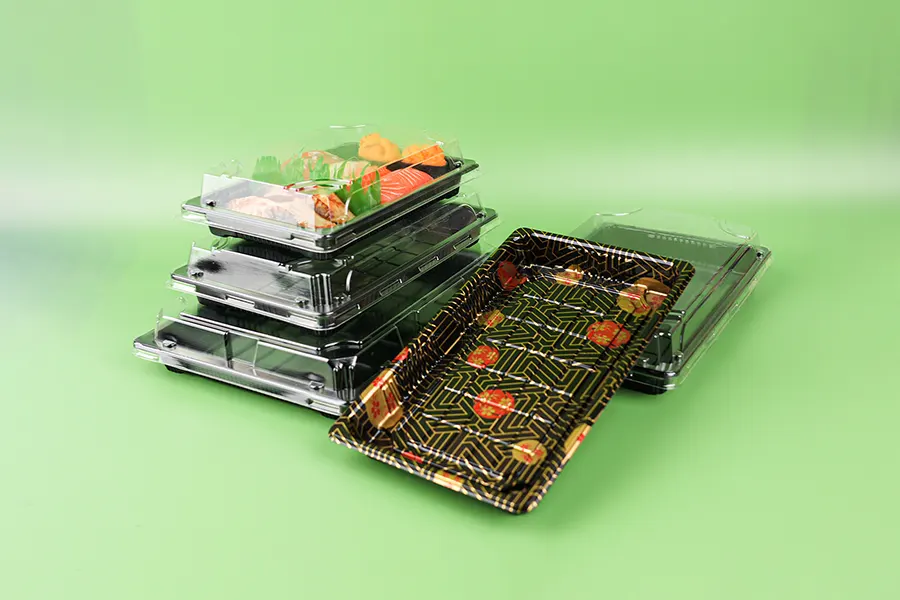
Condensation buildup inside cold display boxes ruins visual appetite appeal and softens crisp garnishes. Our engineered OPS and PET lids incorporate food-grade internal surfactant coatings that disperse moisture droplets into a micro-thin transparent film. This internal anti-fog treatment guarantees crystal-clear visibility even when transferring chilled sushi trays from a 4°C display directly to room temperature.
Lid sealing integrity represents the second critical hurdle in high-volume delivery operations. Standard flat friction lids frequently loosen under internal steam pressure or lateral transit vibration. Precision multi-point perimeter snap grooves create an airtight mechanical lock that prevents liquid leaks while remaining easy for end consumers to open.
In our ISO22000 certified testing lab, container samples undergo 45-degree tilt and vibration cycle simulations under full liquid loads. These stringent quality gates ensure that our custom sushi container designs and partitioned food trays maintain complete seal security throughout rugged delivery routes.
Performance Comparison of Wholesale Takeaway Container Materials
To help procurement teams select optimal packaging formats, our engineering department compiled this comparative performance matrix across core container polymers. Reviewing operating temperature limits and food compatibility prevents container deformation during hot holding or cold chain transit.
| Material | Operating Temperature | Optical Clarity | Microwave Safe | Best Foodservice Application |
|---|---|---|---|---|
| Polypropylene (PP) | -20°C to 120°C | Translucent / Opaque | Yes (High Resistance) | Hot soups, curries, roasted meats & meal prep |
| PET / RPET | -40°C to 65°C | Crystal Clear (>92%) | No | Sushi boxes, cold salads, fruit trays & bakery |
| PLA Bio-Plastic | -20°C to 45°C | High Clarity | No | Eco delis, cold takeaway salads & chilled poke |
| OPS / BOPS Lids | -10°C to 80°C | Ultra-Clear Anti-Fog | No | Premium sushi display covers & bakery lids |
Selecting the proper polymer ensures seamless compliance with international food contact regulations while reducing material over-specification costs. For operations scaling multi-location delivery, combining PP bases with anti-fog PET or OPS lids achieves the ideal balance of thermal safety and merchandising elegance.
Cost vs Quality: Strategic Bulk Sourcing for Disposable Takeaway Containers
Sourcing directly from a tier-1 manufacturing facility eliminates intermediary trading markups and guarantees consistent resin purity. Across our 30,000 square meter facility with 60+ automated production lines, lean extrusion processes ensure dependable carton-to-carton dimensions. This dimensional stability prevents automated denesting jams on fast-paced commercial packing lines.
Furthermore, nesting density plays a decisive role in global shipping cost management. Our engineering team designs optimized stacking taper angles that increase container count per sea freight container by up to 22%. You can also explore our companion guide on bulk plastic cups with lids to consolidate your FCL shipments.
For brand builders, custom embossed logos, partitioned cavity depths, and unique outer sleeve branding create memorable unboxing moments. Partnering with an experienced OEM/ODM factory allows you to develop proprietary molds with rapid 15-day prototyping and full volume scalability.
Supplier Audit Checklist: 5 Verification Steps Before Placing an Order
Before issuing a formal Purchase Order for large-scale container inventory, commercial buyers should demand concrete compliance and test documentation. Requesting these five verified records ensures consistent batch quality and eliminates unexpected regulatory delays at customs checkpoints.
- BRCGS Packaging A+ Audit Certificate: Validates global food safety compliance, cleanroom hygiene, and automated contamination controls across the entire manufacturing floor.
- Overall and Specific Migration Test Reports: Third-party SGS or TÜV documentation confirming compliance with EU Regulation 10/2011 and FDA 21 CFR 177.1520 for food contact safety.
- Anti-Fog Performance Verification: Proof of surfactant longevity under refrigeration (minimum 72 hours at 4°C without surface fogging or droplet accumulation).
- Compressive Stacking Load Test Data: Certified laboratory records verifying that filled, lidded boxes withstand at least 15 kg of static vertical load without buckling.
- Pre-Shipment Quality Inspection Report: Batch-specific dimensional checks, lid snap retention torque data, and optical clarity readings per ANSI/ASQ Z1.4 sampling standards.
As detailed in official guidance from the U.S. FDA Food Contact Substances Notification Program, maintaining full traceability for food packaging resins is mandatory for commercial importers. Reviewing our plastic cup manufacturer audit checklist will provide additional supplier screening criteria.
Frequently Asked Questions
Q: What is the minimum order quantity (MOQ) for custom branded disposable takeaway containers? Our standard production MOQ for custom printed or embossed containers starts at 50,000 units per size specification. For standard unprinted inventory, trial orders start from 10,000 pieces. When evaluating suppliers, always verify if tooling fees are amortized across repeat container orders.
Q: Are PP takeaway container bases fully microwavable and oil-resistant? Yes, our virgin polypropylene containers safely handle microwave reheating up to 120°C without plasticizer leaching or structural softening. The resin formulation resists hot cooking oils and acidic sauces without cracking. Always request certified migration test reports for hot oil contact at 100°C before signing procurement contracts.
Q: How do anti-fog lids maintain clarity in commercial refrigerated displays? Anti-fog lids utilize an internal food-grade surfactant that alters the surface tension of water vapor, preventing droplet formation. At YST Pack, our automated coating line ensures durable anti-fog performance for over 72 hours in cold displays. Ensure your packaging partner verifies surfactant adhesion through standard humidity chamber testing.
For detailed global food contact packaging standards, consult the BRCGS Global Standard for Packaging Materials directory to verify factory compliance ratings. Reviewing third-party facility audits ensures your supply chain maintains consistent cleanroom hygiene.