Compostable Cup Certifications: What Buyers Need to Ver
Compostable Cup Certifications: What Buyers Need to Verify First
If your foodservice business is replacing conventional packaging, compostable cup certifications are not a decorative logo exercise. They determine which claims you can make, which disposal system your customer can use, and whether your procurement team can defend the product during an audit. We help buyers separate a certified compostability claim from a vague “eco” statement before they approve a PLA cup order.
The practical answer is simple: match the certification to the market, material claim, and end-of-life route. BPI is relevant to North American compostability claims, DIN CERTCO commonly supports European certification pathways, and GRS addresses recycled content and chain of custody rather than compostability. Those are different questions, so one mark cannot replace the others.
How Do BPI, DIN CERTCO, and GRS Differ?
BPI certification is a third-party verification program for compostable products in North America. BPI states that certified products meet applicable ASTM compostability standards, follow eligibility criteria connected to food scraps and yard trimmings, address total fluorine limits, and display the BPI Certification Mark. For a North American foodservice launch, ask for the certificate and confirm that the exact cup, lid, color, and printed version are covered.
DIN CERTCO certification is commonly associated with European compostability certification and the Seedling mark. Buyers should confirm the applicable DIN EN 13432 basis, certificate scope, product dimensions, additives, inks, and license status. Do not treat a supplier’s reference to “DIN material” as proof that the finished cup is certified. The finished article and its declared components are what matter.
GRS certification answers a different procurement question. Textile Exchange explains that GRS verifies recycled materials and chain of custody, with additional social, environmental, and chemical requirements. GRS can support recycled-content claims for products such as RPET packaging, but it does not prove that a PLA cup is compostable. If a supplier presents GRS for a compostability claim, ask for clarification rather than accepting the label at face value.
| Certification or claim | Main question it answers | What to request before approval |
|---|---|---|
| BPI | Does the product meet the relevant North American compostability pathway? | Product certificate, mark-use evidence, and exact SKU scope |
| DIN CERTCO / Seedling | Does the product fit the applicable European compostability certification route? | Certificate, standard reference, license status, and component scope |
| GRS | Can recycled content and its chain of custody be verified? | Scope certificate, transaction evidence, and recycled-content declaration |
| Food-contact compliance | Is the packaging suitable for the intended food and market? | Food-contact declaration, migration/test documents, and intended-use limits |
We advise procurement teams to keep these columns separate in their supplier scorecard. A compostable claim, a recycled-content claim, and a food-contact claim can coexist, but they require different evidence.
What Does a Certification Cover on a PLA Cup?
A certificate is only useful when its scope matches the item you will buy. Check the product code, cup size, wall structure, lid pairing, colorant, printing ink, and packaging configuration. A clear 12-ounce cup and a tinted 16-ounce cup may not share the same certification scope, even when both are described as PLA.
At Yasitai, we manufacture PET cups, PLA cups, RPET cups, sushi boxes, food containers, and trays. Our knowledge base records BPI and DIN certifications within the company’s certification portfolio, alongside ISO9001, ISO22000, BRC A+, SGS, and GRS. We still recommend that buyers request product-specific documents for every production brief. That is the responsible way to convert a factory-level credential into a purchase-order decision.
Our production scale also changes how certification control works in practice. With a 30,000 m² facility, more than 60 machines, and monthly capacity of 300 million pieces, document control must be linked to moulds, materials, artwork, and batch records. When we review an OEM request, we confirm the intended market first, then align the material and documentation package before mass production.
How Should Compostable Cup Certifications Map to Each Market?
Start with the destination market and the collection infrastructure, not the supplier’s marketing headline. A BPI mark may be the right evidence for a North American compostability claim, while a European buyer may require documentation aligned with DIN EN 13432 and local labeling rules. A recycled-content program such as GRS should be reviewed separately when the brief includes RPET or another recycled input.
Then define the disposal statement that will appear on packaging, product pages, and sales materials. “Compostable” does not mean that every cup breaks down in a backyard pile or in every municipal system. Your claim should reflect the certified route and the facilities available to your customers.
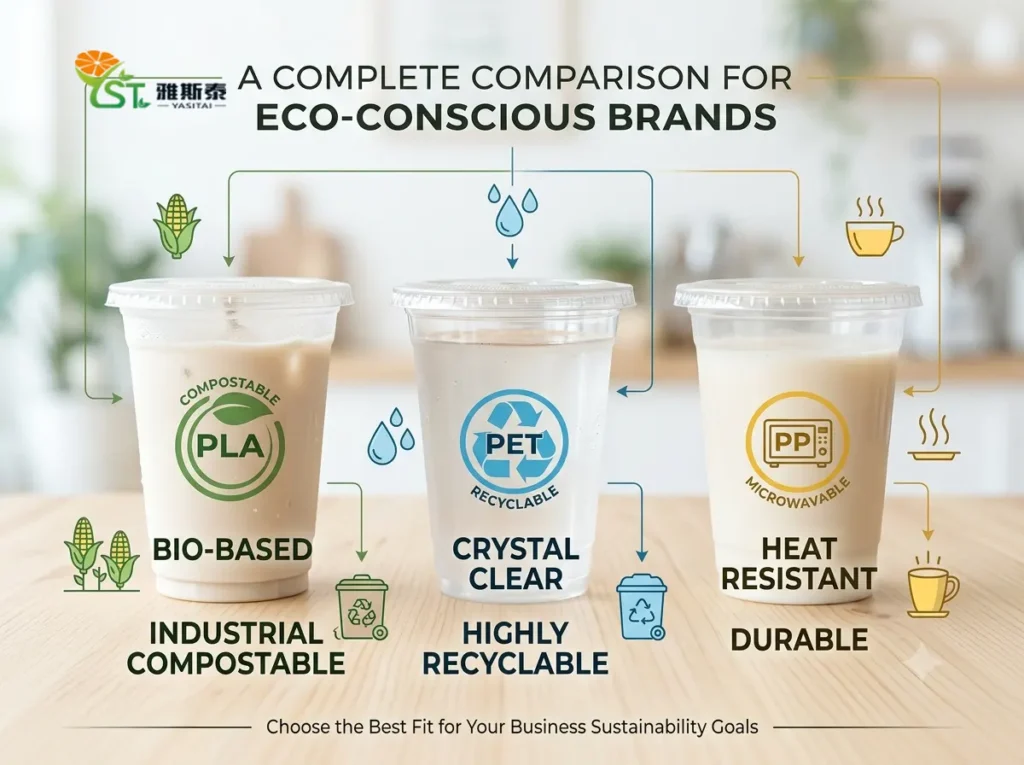
For practical comparison, our PLA vs PET buyer’s guide explains how service conditions, clarity, lid fit, certification, supply continuity, and end-of-life claims affect the material decision. Buyers evaluating recycled-content alternatives can also review our RPET cups manufacturer guide.
5 Critical Mistakes in Compostable Cup Certification Reviews
- Checking the logo but not the certificate scope. The mark should connect to the exact product configuration, not only the raw material.
- Confusing biodegradable with compostable. These terms can carry different technical and marketing implications. Use the wording supported by the certificate and applicable rules.
- Ignoring lids, inks, and additives. The cup may be certified while a paired component is outside the declared scope.
- Using GRS as compostability proof. GRS supports recycled-content and chain-of-custody verification; it is not a compostability certificate.
- Skipping the disposal route. A certified product still needs a realistic collection and processing pathway in the target market.
For standards context, consult the BPI certification program, DIN CERTCO’s certification information, and Textile Exchange’s GRS and RCS overview. These are external reference sources; your supplier’s product documents remain the evidence for your own SKU.
Supplier Audit Checklist: 5 Documents to Request Before Signing a Purchase Order
- Finished-product certification: Confirms the exact cup, lid, size, color, and printed configuration covered by BPI or DIN CERTCO.
- Certificate scope and license evidence: Verifies that the mark can be used for the intended product and market.
- Food-contact declaration and migration reports: Confirms suitability for the food, temperature, and region stated in your specification.
- Material and additive declaration: Helps identify resin type, colorants, inks, coatings, and components that may affect a claim.
- Pre-shipment inspection sample: Verifies that the delivered batch matches the approved sample, artwork, dimensions, and documentation.
FAQ: Compostable Cup Certifications for Procurement Teams
Q: Is BPI the same as DIN CERTCO?
No. They are different certification pathways serving different market expectations. BPI is widely used for North American compostability verification, while DIN CERTCO documentation is commonly requested in European procurement. Confirm the market and the exact certificate scope.
Q: Does a GRS certificate prove that a cup is compostable?
No. GRS verifies recycled material and chain of custody, with additional production requirements. Ask for BPI or DIN CERTCO evidence when the claim is compostability, and ask for GRS evidence when the claim is recycled content.
Q: Can the lid use a different certification from the cup?
It can, but that creates a documentation and disposal communication risk. Request certificates and food-contact documents for the complete cup-and-lid configuration, then ensure the label and customer instructions match the approved scope.
Q: What should we do if a supplier only sends a logo image?
Pause approval and request the certificate number, holder, product scope, validity, and mark-use authorization. A logo image alone does not verify the finished product you intend to purchase.
Q: How does Yasitai support certification-led sourcing?
We combine OEM/ODM production with a documented certification portfolio that includes BPI, DIN, GRS, BRC A+, ISO9001, ISO22000, and SGS. Our 30,000 m² facility, 60+ machines, and monthly capacity of 300 million pieces support scaled production, while buyers should still approve product-specific documents before a purchase order.
Request a Certification Review from Yasitai
If you have a target market, cup size, lid requirement, artwork, or disposal claim, send the brief to our team before you compare quotations. We can help map the requested claim to the appropriate document set and prepare an OEM/ODM sampling discussion.