PLA frente a. Mascota vs. Tazas de PP: Una comparación completa para Eco-
PLA frente a. Mascota vs. Tazas de PP
Elegir el material adecuado para sus vasos desechables para bebidas ya no es solo una cuestión de costo, sino también del rendimiento del producto., compatibilidad de temperatura, y regulaciones ambientales locales. Para cadenas de bebidas, mayoristas de envases, y marcas que se expanden a regiones con estrictas prohibiciones de plástico de un solo uso, comprender las diferencias técnicas entre PLA (Ácido poliláctico), MASCOTA (Tereftalato de polietileno), y PÁGINAS (polipropileno) es critico.
A continuación se muestra un detalle, Comparación basada en datos para ayudarle a tomar una decisión de adquisición informada..
Descripción general de las especificaciones técnicas
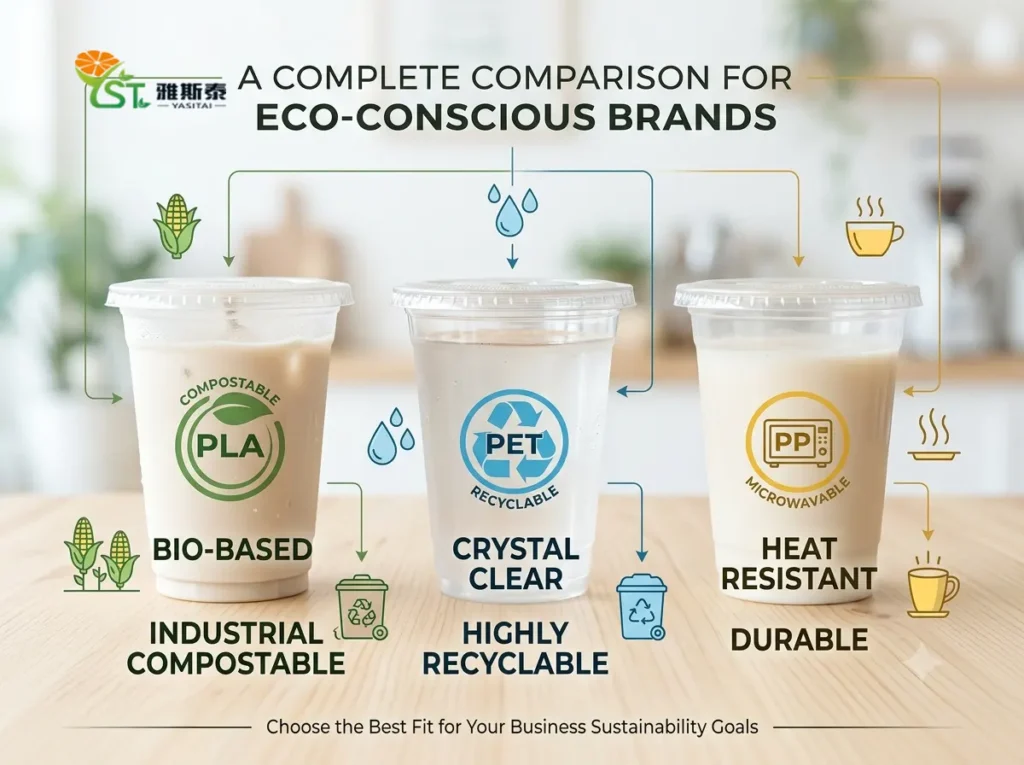
| Característica / Propiedad | PLA (Ácido poliláctico) | MASCOTA (Tereftalato de polietileno) | PÁGINAS (polipropileno) |
| Claridad & Transparencia | Excepcional (Claro) | Excepcional (Claro) | Translúcido / semitransparente |
| Resistencia a la temperatura | Hasta 45°C (113° F) | Hasta 60°C (140° F) | Hasta 110°C (230° F) |
| Adecuado para | Bebidas frías, café helado, batidos | Bebidas frías, café helado, tazas de frutas | Caliente & bebidas frías, calentamiento por microondas |
| Resistencia al agrietamiento | Moderado (Rígido) | Alto (Flexible & Inastillable) | Alto (Flexible, Sensación suave) |
| Método de sellado | Solo tapas a juego. | Solo tapas a juego. | Tapas o Film termosellado |
| Fin de vida / Desecho | Compostaje industrial | 100% Reciclable (RIC 1 / PET) | 100% Reciclable (RIC 5) |
1. PLA (Ácido poliláctico) tazas: La frontera ecológica
El PLA es un plástico de base biológica derivado de recursos renovables como el almidón de maíz o la caña de azúcar..
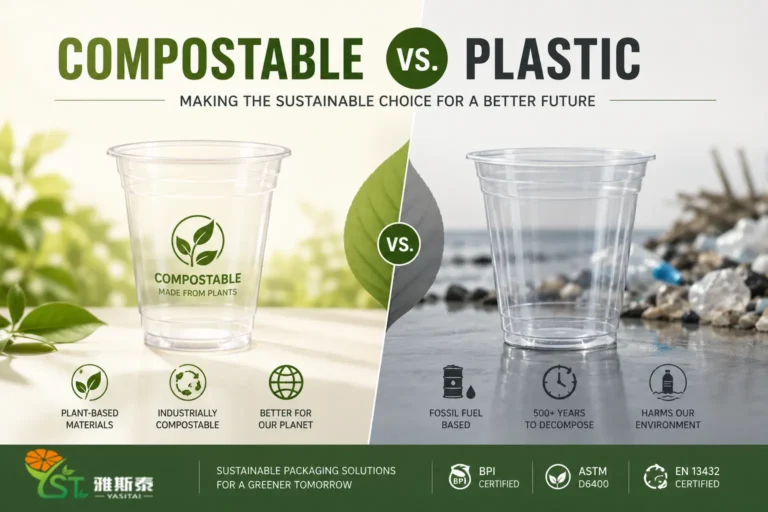
- Impacto ambiental: PLA cumple con estándares internacionales de compostaje como EN 13432 (Europa) y ASTM D6400 (EE.UU). En condiciones de compostaje industrial. (60°C con humedad controlada), El PLA se desintegra en agua y $CO_2$ dentro 90 a 180 días, sin dejar residuos tóxicos ni microplásticos.
- La limitación (Crucial para el envío): El PLA tiene una baja temperatura de distorsión térmica.. Se ablanda y se deforma arriba. 45°C (113° F).Nota de riesgo de adquisiciones: Los vasos de PLA deben enviarse a través de contenedores frigoríficos. (temperatura controlada) durante los meses de verano y almacenado en almacenes con clima controlado, lejos de la luz solar directa.
- Mejor aplicación: Barras de jugos premium, cafés, y eventos corporativos que operan en regiones con estrictos impuestos o prohibiciones sobre el plástico. (p.ej., UE, partes de america del norte).
2. Tazas de mascotas: El estándar cristalino para bebidas frías
El PET es una resina termoplástica a base de petróleo ampliamente reconocida por su claridad óptica superior..
- Estética & Durabilidad: Los vasos de PET ofrecen un acabado brillante que imita al vidrio, maximizar el atractivo visual de las capas coloridas en los cafés con leche helados, tés de burbujas, y parfaits de frutas. Es muy rígido y resistente a roturas., Prevención de grietas durante la entrega a alta velocidad o la manipulación para llevar..
- Contexto de sostenibilidad: Si bien no es biodegradable, El PET es el plástico más reciclado a nivel mundial (Código de identificación de resina 1). Se puede reprocesar continuamente para PET (PET reciclado), Satisfacer los requisitos de la economía circular y reducir la huella de carbono hasta en 60% en comparación con el PET virgen.
- Rango de temperatura: Seguro para temperaturas de hasta 60°C (140° F). No puede soportar bebidas calientes ni uso en microondas..
3. Tazas de PP: El caballo de batalla de alta temperatura
El PP es un producto muy versátil., Polímero de baja densidad conocido por sus excelentes propiedades térmicas y rentabilidad..
- Superioridad de temperatura: Con un punto de fusión alrededor de 160°C, Los vasos de PP pueden soportar cómodamente temperaturas de hasta 110°C (230° F). Esto convierte al PP en la única opción viable entre las tres para el té caliente., sopas, recalentamiento en microondas, y máquinas automáticas de sellado de vasos.
- Flexibilidad & Caza de focas: El PP es más elástico que el PET y el PLA. Se puede sellar herméticamente con una película de plástico impresa personalizada utilizando una máquina de termosellado, una configuración estándar para las cadenas mundiales de té de burbujas para garantizar 100% entrega a prueba de fugas.
- Desventaja de claridad: El PP es naturalmente translúcido.. Mientras “PP de alta claridad” existen opciones, no puede igualar lo impecable, transparencia cristalina de PET o PLA.
Matriz de decisión de adquisiciones: ¿Cuál deberías comprar??
- Elija PLA si: Su mercado objetivo impone fuertes multas a los plásticos tradicionales, la identidad de su marca gira en torno al desperdicio cero y la compostabilidad, y solo sirve bebidas frías por debajo de 45°C.
- Elija PET si: Presentación premium, alta claridad, y la resistencia al agrietamiento son sus principales prioridades para las bebidas heladas, y tu requieres 100% envases reciclables.
- Elija PP si: Necesitas una solución rentable, taza versátil que maneja líquidos fríos y calientes, o su flujo de trabajo operativo depende de una película termosellable en lugar de tapas de plástico a presión.
Cómo YSTPACK Asegura su cadena de suministro
En YSTPACK (Productos de embalaje Co. de Shenzhen Yaste., Limitado.), Fabricamos los tres materiales utilizando líneas de termoformado y moldeo por inyección de alta precisión..
- Nuestros productos pasan estrictos Certificaciones de seguridad de materiales en contacto con alimentos de la FDA y la UE.
- Utilizamos calidad alimentaria., libre de olores tintas a base de soja para toda la impresión de logotipos personalizados.
- Garantizar un transporte marítimo seguro a larga distancia, Todos los pedidos al por mayor se embalan en cajas de alta resistencia. 5-cajas de cartón corrugado en capas con bolsas de polvo internas de PE de alta presión para evitar la deformación durante el tránsito.
Buscando personalizar su próximo lote de vasos de marca?
Póngase en contacto con nuestro equipo de ingeniería de embalaje hoy para obtener desgloses de costos específicos, cronogramas de moldes personalizados, y opciones de carga mixta optimizadas para el transporte.