PLA contre. Animal de compagnie. Tasses PP: Une comparaison complète pour Eco-
PLA contre. Animal de compagnie. Tasses PP
Choisir le bon matériau pour vos gobelets jetables n'est plus seulement une question de coût : c'est aussi une question de performance du produit., compatibilité de température, et les réglementations environnementales locales. Pour les chaînes de boissons, grossistes en emballages, et des marques se développant dans des régions où le plastique à usage unique est strictement interdit, comprendre les différences techniques entre PLA (Acide polylactique), ANIMAL DE COMPAGNIE (Polyéthylène téréphtalate), et PP (Polypropylène) est critique.
Ci-dessous un détail, comparaison basée sur les données pour vous aider à prendre une décision d'approvisionnement éclairée.
Aperçu des spécifications techniques
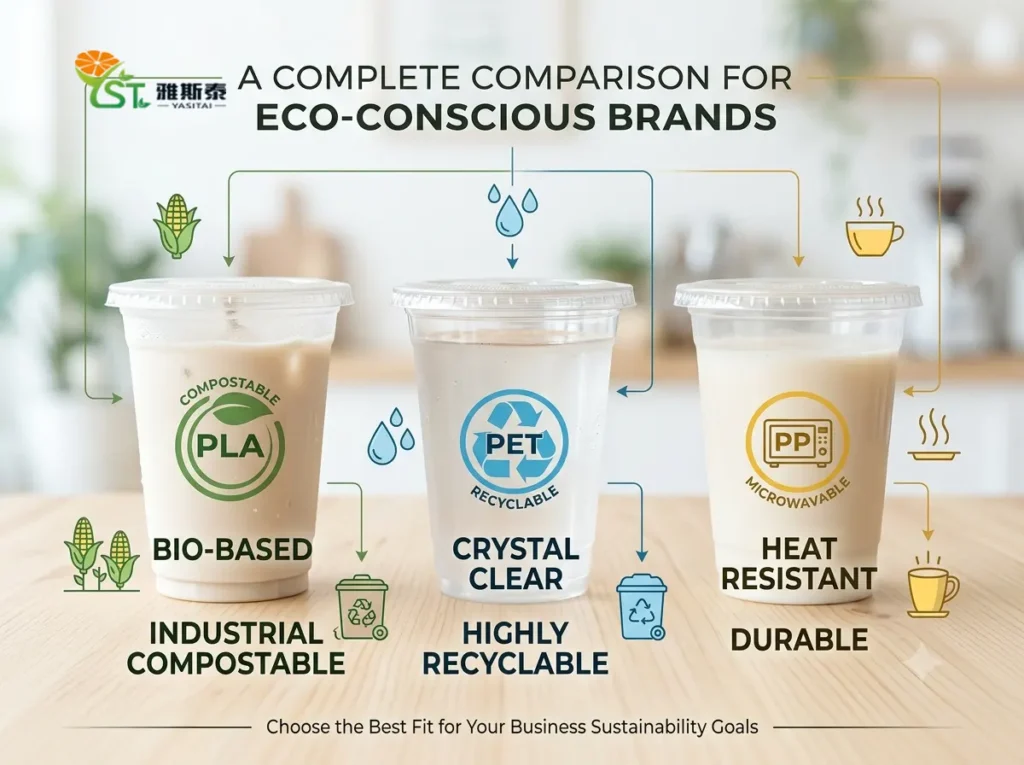
| Fonctionnalité / Propriété | PLA (Acide polylactique) | ANIMAL DE COMPAGNIE (Polyéthylène téréphtalate) | PP (Polypropylène) |
| Clarté & Transparence | Exceptionnel (Clair comme du cristal) | Exceptionnel (Clair comme du cristal) | Translucide / Semi-clair |
| Résistance à la température | Jusqu'à 45° C (113° F) | Jusqu'à 60° C (140° F) | Jusqu'à 110° C (230° F) |
| Convient pour | Boissons froides, café glacé, smoothies | Boissons froides, café glacé, coupes de fruits | Chaud & boissons froides, chauffage par micro-ondes |
| Résistance à la fissuration | Modéré (Rigide) | Haut (Flexible & Incassable) | Haut (Flexible, Toucher doux) |
| Méthode de scellement | Couvercles assortis uniquement | Couvercles assortis uniquement | Couvercles ou film thermoscellable |
| Fin de vie / Élimination | Compostage industriel | 100% Recyclable (RIC 1 / rPET) | 100% Recyclable (RIC 5) |
1. PLA (Acide polylactique) Tasses: La frontière écologique
Le PLA est un plastique d'origine biologique dérivé de ressources renouvelables comme l'amidon de maïs ou la canne à sucre..
- Impact environnemental: Le PLA est conforme aux normes internationales de compostage telles que DANS 13432 (Europe) et ASTM D6400 (USA). Dans des conditions de compostage industriel (60°C avec humidité contrôlée), Le PLA se désintègre dans l'eau et $CO_2$ à l'intérieur 90 à 180 jours, ne laissant aucun résidu toxique ni microplastique.
- La limite (Crucial pour l’expédition): Le PLA a une faible température de distorsion thermique. Il se ramollit et se déforme dessus 45° C (113° F).Note sur les risques en matière d'approvisionnement: Les gobelets PLA doivent être expédiés via des conteneurs frigorifiques (à température contrôlée) pendant les mois d'été et stocké dans des entrepôts climatisés à l'abri de la lumière directe du soleil.
- Meilleure application: Barres à jus haut de gamme, cafés, et événements d'entreprise se déroulant dans des régions soumises à des taxes ou interdictions strictes sur le plastique (par ex., UE, certaines parties de l'Amérique du Nord).
2. Tasses pour animaux de compagnie: La norme cristalline pour les boissons froides
Le PET est une résine thermoplastique à base de pétrole largement reconnue pour sa clarté optique exceptionnelle..
- Esthétique & Durabilité: Les gobelets en PET offrent une finition brillante qui imite le verre, maximiser l'attrait visuel des couches colorées dans les lattés glacés, thés à bulles, and fruit parfaits. Il est très rigide et incassable, éviter les fissures lors d'une livraison à grande vitesse ou d'une manipulation à emporter.
- Contexte de durabilité: Bien que non biodégradable, Le PET est le plastique le plus recyclé au monde (Code d'identification de la résine 1). Il peut être retraité en continu en rPET (PET recyclé), satisfaire aux exigences de l’économie circulaire et réduire l’empreinte carbone jusqu’à 60% par rapport au PET vierge.
- Plage de température: Sans danger pour des températures allant jusqu'à 60° C (140° F). Il ne peut pas gérer les boissons chaudes ou l'utilisation du micro-ondes.
3. Tasses PP: Le cheval de bataille à haute température
Le PP est un matériau très polyvalent, polymère de faible densité connu pour ses excellentes propriétés thermiques et sa rentabilité.
- Supériorité de la température: Avec un point de fusion autour de 160°C, Les gobelets en PP peuvent résister confortablement à des températures allant jusqu'à 110° C (230° F). Cela fait du PP la seule option viable parmi les trois pour les thés chauds., soupes, réchauffage au micro-ondes, et machines automatiques à sceller les gobelets.
- Flexibilité & Scellage: Le PP est plus élastique que le PET et le PLA. Il peut être hermétiquement scellé avec un film plastique imprimé personnalisé à l'aide d'une machine de thermoscellage, une configuration standard pour les chaînes mondiales de bubble tea pour garantir 100% livraison étanche.
- Inconvénient de la clarté: Le PP est naturellement translucide. Alors que “PP haute clarté” des options existent, il ne peut pas égaler le parfait, transparence cristalline du PET ou du PLA.
Matrice de décision en matière d'approvisionnement: Lequel devriez-vous acheter?
- Choisissez PLA si: Votre marché cible impose de lourdes amendes aux plastiques traditionnels, votre identité de marque s'articule autour du zéro déchet/compostabilité, et vous ne servez que des boissons froides en dessous de 45°C.
- Choisissez PET si: Présentation haut de gamme, haute clarté, et la résistance aux fissures sont vos principales priorités pour les boissons glacées, et tu as besoin 100% emballage recyclable.
- Choisissez PP si: Vous avez besoin d'un produit rentable, tasse polyvalente qui gère les liquides chauds et froids, ou votre flux de travail opérationnel repose sur un film thermoscellable plutôt que sur des couvercles en plastique à clipser.
Comment YSTPACK Sécurise votre chaîne d'approvisionnement
À YSTPACK (Produits d'emballage Cie. de Shenzhen Yaste., Ltd.), nous fabriquons les trois matériaux en utilisant des lignes de thermoformage et de moulage par injection de haute précision.
- Nos produits passent strictement Certifications de sécurité des matériaux en contact avec les aliments de la FDA et de l'UE.
- Nous utilisons des produits de qualité alimentaire, sans odeur encres à base de soja pour toute impression de logo personnalisé.
- Pour assurer la sécurité du transport maritime longue distance, toutes les commandes en gros sont emballées dans des emballages robustes 5-cartons ondulés de couche avec sacs à poussière internes en PE haute pression pour éviter la déformation pendant le transport.
Vous cherchez à personnaliser votre prochain lot de gobelets de marque?
Contactez notre équipe d’ingénierie d’emballage dès aujourd’hui pour obtenir une ventilation spécifique des coûts, délais de moule personnalisés, et options de chargement mixte optimisées pour le fret.